

Playback. Steina. until January 12, 2025. MIT List Visual Arts Center, Cambridge – United States
Steina: Playback presents the first solo exhibition in over a decade of Steina, the pathbreaking media artist whose work traverses video, performance, and installation.
Since cofounding The Kitchen in New York City in 1971, Steina has created works shaped by her experimental approach to electronic processing tools, persistent explorations of what she called “machine vision,” and an enduring ethos of play. A classically trained violinist, Steina took up video in 1970, bringing to her new instrument—initially a Sony Portapak—a musician’s attention to the “majestic flow of time.” Unlike many of her peers working in video in its early decades, the Icelandic-born artist did not consider US television culture a central force against which her video activity was defined. Instead, human perception was a key site of confrontation as she sought the exuberant and even utopian possibilities of an “intelligent, yet not human vision.”

With more than a dozen single-channel works, as well as multi-monitor arrays and multi-channel environments, this focused retrospective surveys Steina’s fearless DIY approach to new media and her pioneering synthesis of the electronic and the natural. While Steina’s early collaborative works with her life partner Woody Vasulka centered largely around the pair’s obsession with video’s signal and the custom-designed hardware that could distort and manipulate it, her independent works from 1975 onward probe the limits of human perspective and pursue non-anthropocentric modes of visualizing the natural world. Throughout her career, her works were continually shaped by her shifting environments: from downtown New York’s avant-garde and Buffalo’s experimental media arts scene of the 1970s, to the vast landscapes of New Mexico and Iceland. In her works from the 1990s onward, new projection technologies allowed her video environments to become even more immersive: flows of river, waves, light, and wind spatialize what the human eye cannot see and seem to offer analogues of the electronic flow of video and audio signals. With her distinctive translation of musical modes, like polyphony, into the visual realm and her effort to exceed human perception, Steina reveals an electronic sublime and attunes us to the vibrant, invisible energies inherent to both video and natural phenomena.
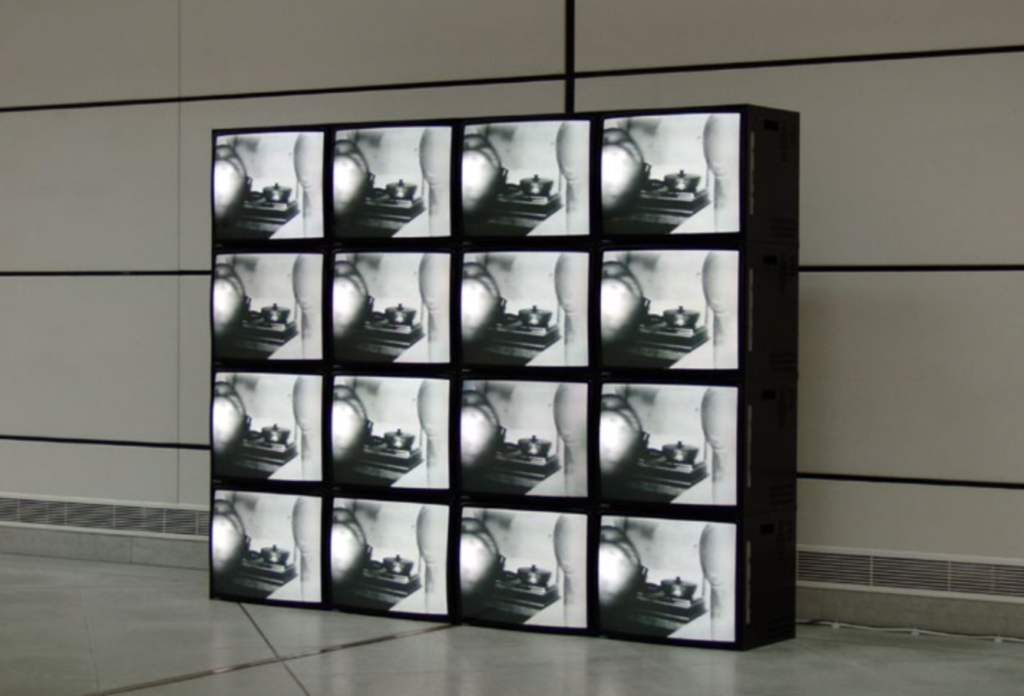
Steina (b. Steinunn Briem Bjarnadottir, 1940, Iceland; lives in Santa Fe, NM) trained as a violinist in Reykjavik and Prague, and emigrated to New York City in 1965 with her life partner, Woody Vasulka. Initially working as a freelance musician, she began to focus on video in 1970, and in 1971, cofounded The Electronic Kitchen (later The Kitchen), the legendary alternative art space. After moving to Buffalo in 1973, Steina helped develop the production lab at the Center for Media Study at SUNY Buffalo. Steina has shown at leading institutions internationally, including the Centre Georges Pompidou, Paris; Museum of Art, Carnegie Institute, Pittsburgh (now the Carnegie Museum of Art); San Francisco Museum of Modern Art; and the Whitney Museum of American Art, New York, among others. Important collections with her work include the Museum of Modern Art, New York; Smithsonian American Art Museum; San Francisco Museum of Modern Art; the Julia Stoschek Foundation; Tate, London; Thyssen-Bornemisza Art Contemporary; and ZKM | Center for Art and Media Karlsruhe. Awards and grants include: Rockefeller Foundation and NEA grants (1982); the Maya Deren Award (1992); the Siemens Media Arts Prize from ZKM | Center for Art and Media Karlsruhe, Germany (1995); as well as an honorary doctorate from the San Francisco Art Institute (1998).


